
The PCI Coaching Model™
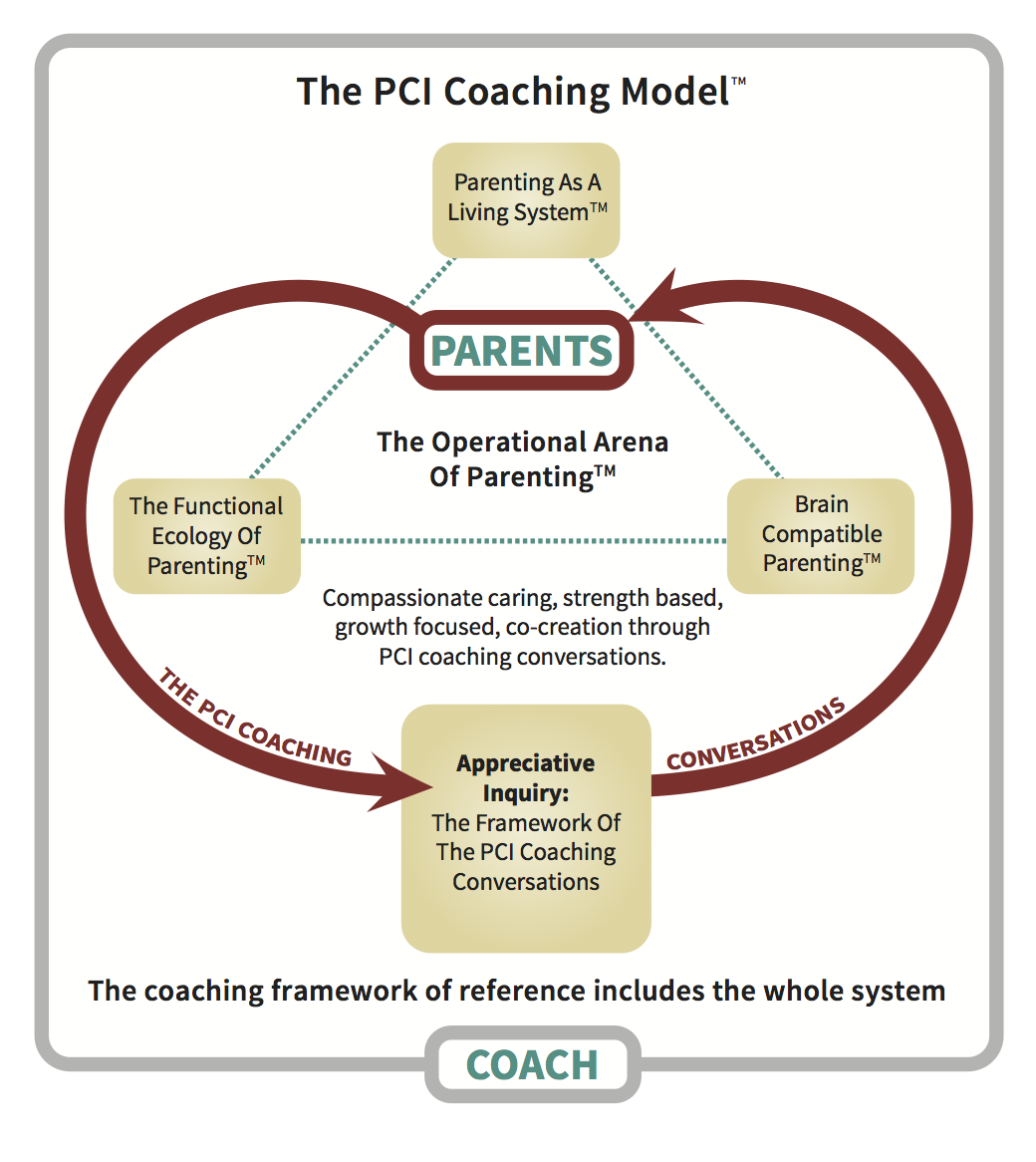
The Four Components of the PCI Coaching Model™
-
Parenting as a Living System
Parenting is viewed as a process made up of living systems, not mechanical systems that need to be "fixed" so they will function properly. Instead, parents and children are seen as growing, dynamic beings, each with individual strengths, talents, and creative capabilities, who are shaped and developed by relationships. It is the relationships within the living system that provide the key to growth. Parenting as a Living System™ also includes living system and change process principles as guiding principles for constructing life-affirming coaching techniques and effective parenting strategies based on accurate information regarding how humans grow, change, and sustain positive changes over time.
-
The Functional Ecology of Parenting™
Parents and children live in a multi-layered web of connections and influences that form a functional ecological system. This system includes family, community, schools, social institutions, religious institutions, and the cultural influences of mass media images and messages. Parental decisions are made daily within the context of this ecological web, as it uniquely impacts each parent and each child. Thus, the environment, from micro-to-macro levels, plays a vital role in co-creating new realities for families. PCI Coaches are trained to observe the influences of these different environments on the child-parent relationship and to harness the best of the influences for optimal child development and healthy family functioning.
-
Brain-Compatible Parenting™
The human brain grows through many developmental stages. Each child needs appropriate support at the various stages of development to nurture and sustain healthy physical, cognitive, emotional, and social growth. While there are needs that are common to each stage of growth that apply to all children, within that commonality, each child is unique in some of its developmental needs and in the timing of its growth. Children do not grow according to averages or statistics. Brain-Compatible Parenting™ recognizes and responds to the ordered process by which the human brain develops as the child grows, while allowing for the uniqueness of each child within this process. Fifteen components of Brain-Compatible Parenting™ form a frame by which PCI Coaches help parents align their parenting decisions with best practices evidenced from brain science.
Please note: In the diagram of the PCI Coaching Model™ above, the three processes listed above form a triangle that is labeled Operational Arena of Parenting™. Parenting decisions are made within the dynamics of this arena. When parenting challenges emerge, it is often because of conflicting dynamics in this parenting arena, and/or developmental needs that are not being recognized and adequately addressed in a timely manner. -
Appreciative Inquiry
Appreciative Inquiry (AI), a powerful change process with a proven track record n the field of organizational development, has been adapted to provide the framework for PCI Coaching Conversations. The four stages of the AI process embeds the relationship between the parent(s) and the coach in a framework of five AI principles, positive psychology, while using a vocabulary of hope, which leverages the strengths of the parent(s) and the children to nurture the growth that helps to create a solution/s to the parenting challenge.
The PCI Coaching Model™ is Unique and is Protected by Two Registered Trademarks
-
Parent Coach Certification®
This trademark applies to the training program developed and administered by Parent Coach International that is based on the PCI Coaching Model™.
-
PCI Certified Parent Coach®
This trademark applies to a person who has successfully completed all of the requirements of Parent Coach Certification® training, as administered by Parent Coach International.
In summary, a PCI Certified Parent Coach® is a professional who through the PCI Coaching Model™ is trained to catalyze positive, transformative change in parents and families, because we know that when moms and dads parent well, they transform the world, one life, one family at a time.